
Laboratory of Anmo J Kim

Research
Reverse-engineering the fly brain


Visual Processing 시각정보처리

Even most advanced computer algorithms –– Facebook face tagging function, in this example –– fail to detect human faces that we can readily recognize (red arrows indicate errors).
Related research papers:
Higher-order Visuomotor Processing
고차원 시각 패턴 처리
We can effortlessly recognize others' faces from complex backgrounds and distinguish subtle differences in facial expressions. Such abilities can easily outperform state-of-the-art computer algorithms. How does a brain accomplish such a remarkable feat? We approach this question by studying the fruit fly's visual system. Owing to their premiere genetic toolkits, fruit flies have become one of the most popular model organisms in neuroscience. This tiny insect invests more than half of their neurons into visual processing and exhibits a large repertoire of higher-order visuomotor functions, including object recognition/tracking, object avoidance, object distance estimation, selective attention, place learning, and gap width estimation. In our lab, we study how such visual features are represented in a neural circuit and trigger specific behavioral programs.
우리는 복잡한 배경의 사진에서도 사람의 얼굴을 쉽게 인식할 수 있지만, 현대의 가장 발전된 컴퓨터 알고리즘도 이런 사람의 능력을 따라가지 못합니다. 본 연구실은 신경세포들로 구성된 우리의 뇌회로가 어떻게 이런 놀라운 능력을 구현하는지를 연구합니다. 구체적으로, 초파리의 시각신경 시스템을 연구함으로써 이 질문에 대한 실마리를 찾으려고 합니다. 초파리는 뇌세포의 반 이상을 시각신경에 사용하고 있으며, 다양한 고차원의 시각 패턴에 반응합니다. 초파리의 고차원 시각 정보 처리를 담당하는 신경회로를 연구함으로써, 인공지능 등의 공학적 문제에 대한 해답을 제공하기를 기대합니다.
Flight control 비행제어
Using the whole-cell patch clamp technique, we can record the membrane potential of a single visual neuron from a flying fruit fly. We showed that, during rapid flight turns, this neuron and some other neurons receive strong non-visual input whose dynamics is consistent with internal predictions for disengaging stability control.
Flight Control via Internal Predictions
내부예측신호에 의한 비행제어
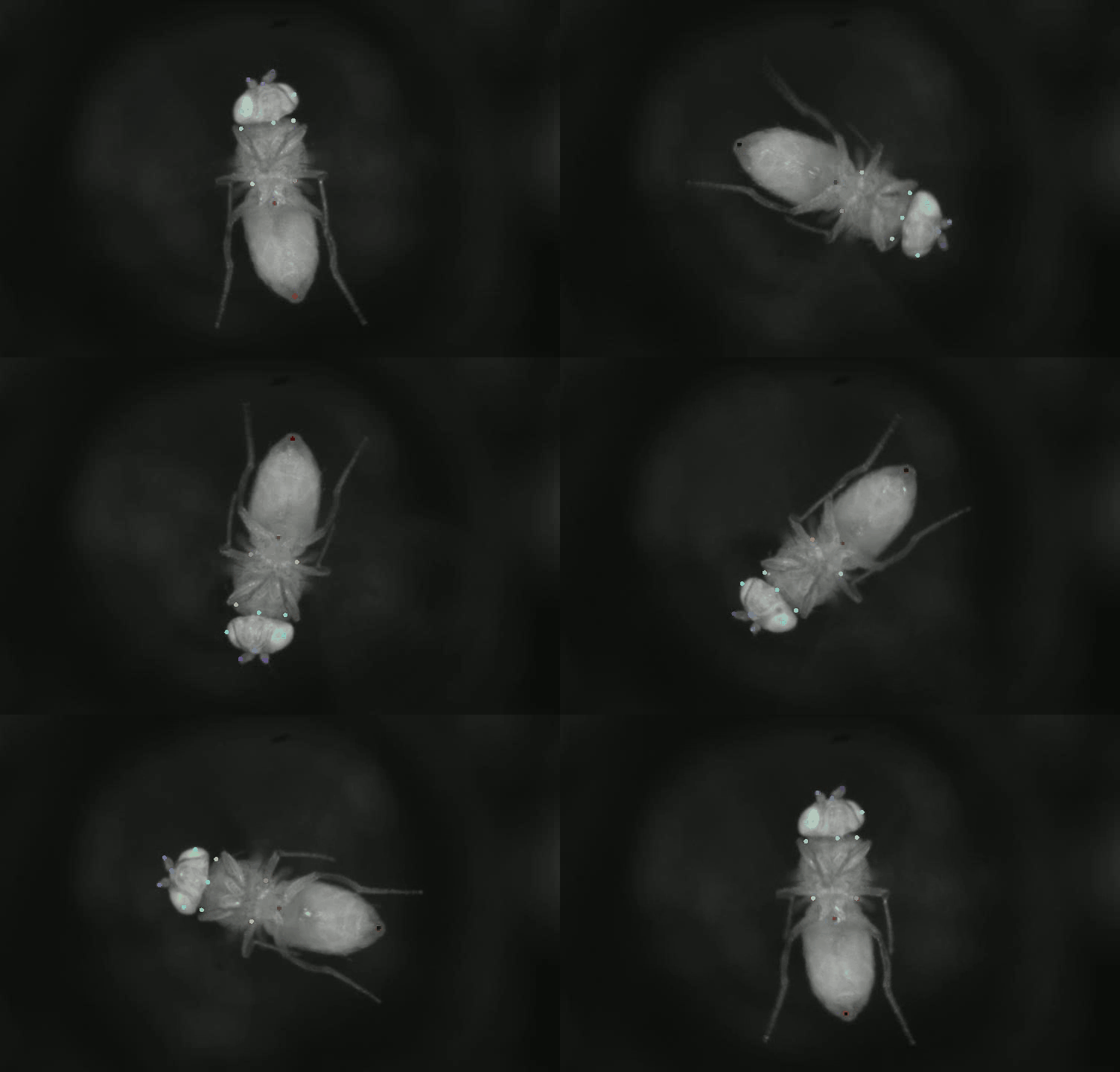
Fruit flies are agile fliers. With wings that beat 200 times a second, they can hover, fly straight, avoid collision, turn rapidly, and even land on an improbable target, such as a ceiling. To make these sophisticated flight maneuvers, fruit flies constantly make use of their sensory feedback. In two previous studies (Cell 2017 and Nat Neurosci 2015), we demonstrated how a set of visual neurons guides fruit fly’s stabilization behaviors and how their visual signaling is quantitatively modulated by internal predictions to enable rapid flight turns. We aim to develop this study further by uncovering the detailed circuit mechanism of internal predictions.
초파리는 사람이 만든 어떤 자율비행시스템보다 우수한 비행제어를 보여줍니다. 1초에 200번의 날개짓을 미세하게 제어함으로써, 초파리는 호버링, 직진비행, 장애물회피, 재빠른 방향전환 등을 해내고, 심지어는 천장에도 착륙할 수 있습니다. 이런 복잡한 비행제어 행동을 위해서, 초파리는 지속적으로 신경시스템으로 들어오는 피드백 신호를 이용하여 자세를 제어합니다. 우리는 최근 연구에서 (Cell, 2017 and Nature Neuroscience, 2015), 초파리의 특정 시각 신경 세포들이 어떻게 비행중 자세를 제어하고, 빠른 방향전환을 위해 어떻게 내부예측신호에 의해 정밀하게 조절되는지를 보였습니다. 우리는 이 내부예측신호가 초파리 뇌의 어떠한 곳에서 어떤 방식으로 만들어지는지를 연구하고 있으며, 더불어 외부 시각자극을 통해 비행자세를 제어하는 기작에 대해서도 연구하고 있습니다.
Brain-inspired Models 뇌모방제어모델
We are developing a new control algorithm inspired by the predictive control mechanism that we discovered from the fruit fly brain. This algorithm will permit aggressive flight maneuvers that a traditional closed-loop control algorithm cannot afford.

Related research papers:
Modeling Brain-inspired Predictive Control
뇌모방 예측제어 모델
Flies' flight abilities outperform any man-made flying device, in terms of their stability, adaptability, maneuverability, and robustness. For this reason, quantitative analyses of neural mechanisms underlying flies' flight control is likely to help developing new solutions for man-made robots. In particular, the forward model can predict sensory feedback caused by a self-generated action, and that prediction can be used to selectively pass or block the neural signals from the sensory periphery. During flight, such control mechanisms can momentarily switch off the powerful stabilization system and permit aggressive flight maneuvers. Currently, we are developing a computational model of this control mechanism to apply it to simple engineering systems, such as an inverted pendulum or an unmanned air vehicle (i.e., drone).
우리는 초파리 비행 제어 메커니즘의 수학적 모델을 밝힘으로써 엔지니어링 문제에 대한 새로운 해결책을 제시하고자합니다. 구체적으로, 포워드 모델은 우리의 자발적 행동이 감각시스템에 어떤 피드백을 주는지 예측하며, 감각시스템이 선택적으로 외부자극에 반응하게 해 줍니다. 특히 비행중 포워드모델을 이용한 초파리의 제어알고리즘은 비행중 동작하는 강력한 비행 안정 모듈을 순간적으로 억제하고, 초파리가 공세적인 비행동작을 구현 할 수 있게 해 줍니다. 우리는 초파리의 비행중 얻은 생체전기신호에 기반한 수학적 알고리즘을 개발하고, 도립진자나 드론 같은 간단한 제어 시스템에 적용하는 연구를 진행하고 있습니다.
Navigation 항법 및 공간기억

Circuits for Navigation and Spatial Memory
공간기억 형성 및 항법 행동 신경회로
Flies can perform diverse navigational tasks nicely from long distance flight to short distance pathfinding. This kind of ability is necessary for many animals to move around space, and it makes this field as one of the most actively studied areas in neuroscience. Flies can perform navigation even with their small brains, so flies can be a good model organism to study mechanism underlying navigation.
With this fly brain, we study how flies can perform navigation and make spatial memory, specifically in visual aspect with biological experiment and computational modeling. We expect this research to contribute to finding basic neural mechanisms, and also to developing AI navigation systems.
초파리는 장거리 비행부터 단거리 경로 탐색까지 다양한 항법 문제(navigational task)를 원활히 수행할 수 있습니다. 이러한 수행 능력은 다양한 공간을 이동해야 할 동물들에게 필수적인 것으로서, 현재 신경과학 분야에서 활발히 연구되고 있는 주제 중 하나입니다. 초파리는 작은 뇌를 가지고도 이러한 항법 행동을 할 수 있는 동물로서, 그 원리를 연구하기에 간단하고 좋은 모델 동물이라 할 수 있습니다.
우리는 이와 같은 초파리를 이용하여 어떻게 다양한 항법 행동이 이루어지고, 복잡한 공간기억이 형성되는지, 특히 시각적인 측면에서 생물학적 실험과 수학적 모델링을 통해 연구하고 있습니다. 이러한 연구는 신경과학에 대한 기초연구를 넘어 AI 항법 시스템 개발 등에도 기여할 수 있으리라 생각합니다.
Brain-inspired robots 뇌모방로봇

Brain-inspired autonomous robots
뇌모방 알고리즘 기반 자율 이동 로봇
What if we had robots that were as small as fruit flies, capable of both walking and flying, could find their own power source and recharge, had various sensory organs to detect objects, and could remember locations? In our lab, we are working on implementing behavioral algorithms discovered through fruit fly neuroscience into robots. We've developed drones that mimic the visual circuits of fruit flies and tested low-power camera-based flight technology. Additionally, we are working on creating robots that mimic insect olfactory behaviors and use multisensory (visual, olfactory, auditory) sensor information to track the location of objects.
초파리처럼 작고, 보행과 비행을 자유자재로 하고, 스스로 전원을 찾아 충전을 하고, 다양한 감각 기관으로 물체를 찾아가고, 위치를 기억하는 로봇이 있다면 어떨까요? 우리 연구실을 초파리 뇌과학을 통해 발견된 행동 알고리즘을 하드웨어 로봇으로 구현하는 연구를 진행하고 있습니다. 초파리의 시각회로를 그대로 모방한 알고리즘을 구현한 드론을 개발하여, 저전력 카메라 기반 비행 기술을 테스트하였습니다. 또한, 곤충의 후각 행동을 모방하여 다감각(시각, 후각, 청각) 센서 정보를 활용하여 물체의 위치를 추적하는 탐지로봇을 개발하고 있습니다.
Artificial Nose 전자코

Can we make ultra-sensitive odor sensors using Drosophila olfaction?
Have you ever dealt with pesky summer fruit flies and wondered how they pinpoint fruit peels to munch on and lay eggs? Insects' sense of smell has been a hot research topic. For instance, male moths can trace female moths' pheromones from 1.7 kilometers away within an hour! Our lab's exploring genetically engineered odor-sensitive fruit flies, especially those attracted to drug scents. We're also creating a system to visualize odor responses as fluorescent signals, helping us detect and measure odors in images.
여름에 집에 생긴 초파리 때문에 불편했던 경험이 있으신가요? 초파리는 어떻게 정확히 과일 껍질이 있는 곳을 찾아가서 배를 채우고 알을 낳을까요? 곤충의 후각은 일찍부터 높은 민감도로 주목을 받았습니다. 1.7km거에 있는 암컷 나방의 페로몬을 따라 한시간 만에 찾아가는 수컷 나방이 좋은 예입니다. 우리 연구실에서는 곤충의 후각 시스템을 유전자 조작하여 고민감도의 냄새 센서를 개발하는 연구를 진행하고 있습니다. 구체적으로, 마약 냄새에만 강한 끌림 현상을 보이는 초파리를 개발하고, 이들의 군집행동을 분석하는 시스템을 개발하였습니다. 후속 연구를 통해 냄새 반응 신호를 형광 신호로 환원하여 영상을 통해 냄새의 유무와 농도를 파악할 수 있는 시스템을 개발하고 있습니다.
What's new in the lab?


